What is a government shutdown?
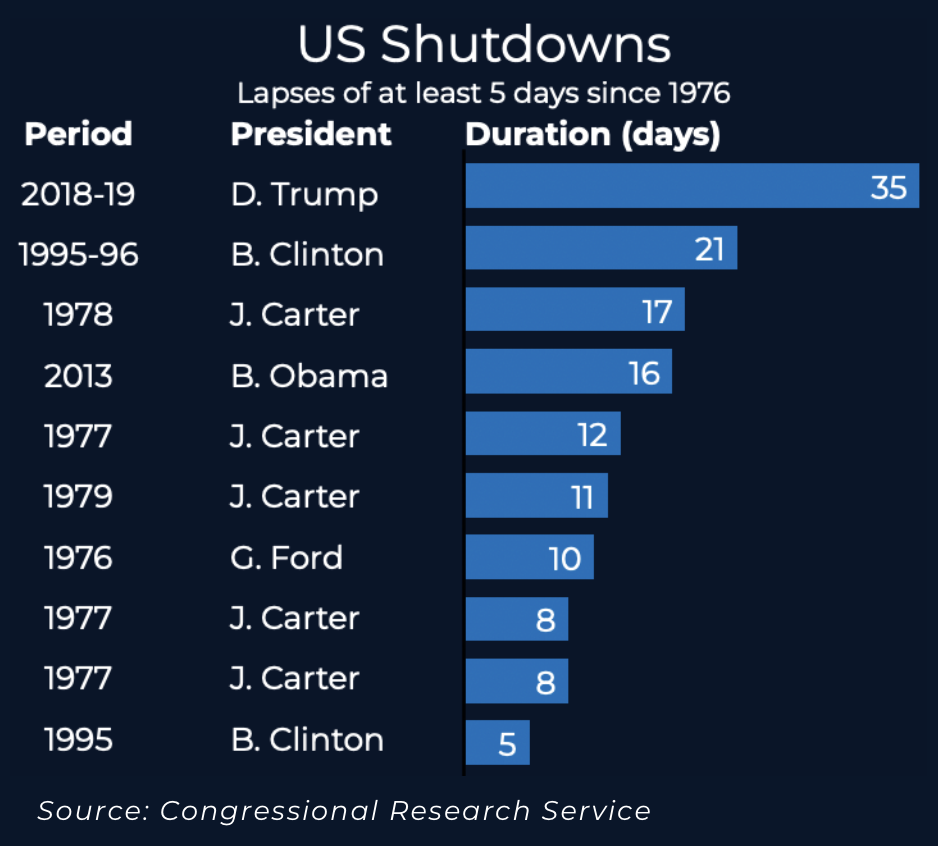
A government shutdown refers to the suspension of all non-essential public services. This occurs when Congress fails to approve a funding plan for federal agencies that is enacted by the President before the new fiscal year begins.
The deadline to resolve federal government funding was September 30th. However, on the same day, the House of Representatives and the Senate passed a law extending it for 45 days until November 17th.
Political Tensions
- Disagreements between the Democrat-controlled Senate and the Republican-controlled House of Representatives have made it challenging to approve the funding plan. The far-right Republicans aim to significantly cut public spending in their proposal.
- The extension of the deadline created additional tensions. The former House Speaker, Kevin McCarthy, managed to garner bipartisan support to extend funding for government agencies but without including new funds for Ukraine or border security, which were major points of contention between the parties.
- This recent event led to McCarthy's removal from his position as House speaker, a decision driven by those seeking aggressive budget cuts and unwilling to grant an extension.
Consequences on the Economy and the Market
- The magnitude of the consequences will depend on the duration of the shutdown and will primarily affect areas with a strong government presence. Non-essential federal employees will be furloughed and will receive their back pay.
- According to JP Morgan studies, the impact of a shutdown on the GDP is around 0.1% for each week of its duration, and most of that activity quickly recovers when the shutdown ends.
- Major federal statistical institutes will be unable to produce their usual economic data, which could hinder decisions by the Federal Reserve.
- Financial markets may experience higher volatility in the early days of a government shutdown due to uncertainty.
- Government shutdowns tend to have a minimal impact on the stock market. However, sectors heavily reliant on government contracts, such as defense and healthcare, may experience disruptions in their business activities, leading to a decrease in their stock prices.


