How could this affect companies and the market?
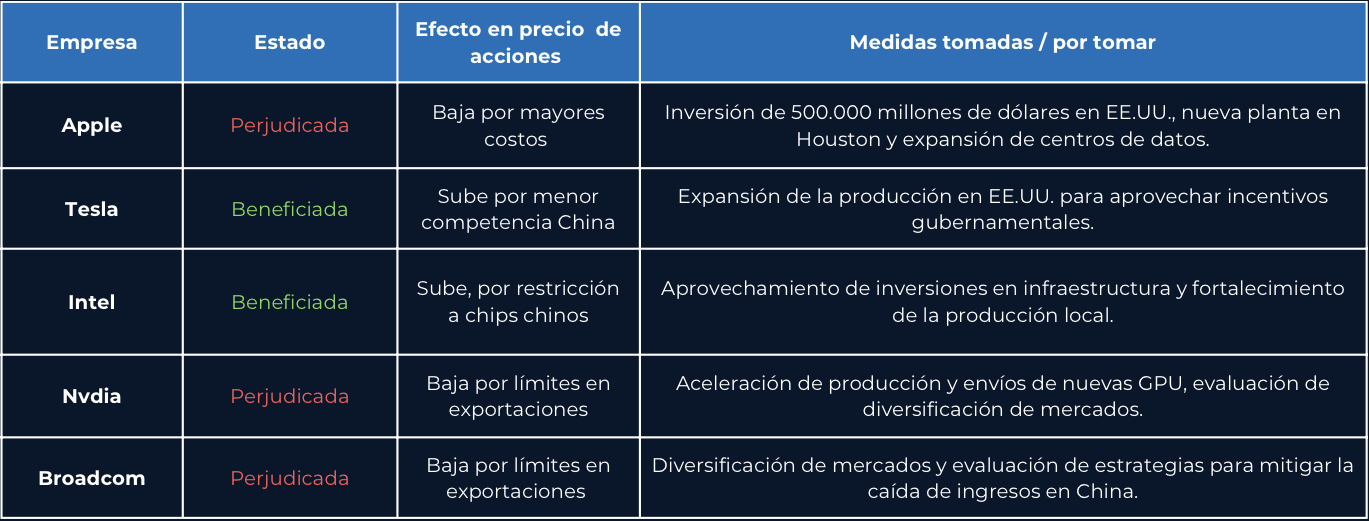
Trump's tariff policies will have an uneven impact on companies, ultimately impacting the stock market. Companies that rely on imports may face higher costs and a loss of competitiveness. For example, Apple relies on Chinese assembly for its products, which could lead to increased costs. In response, the company announced a $500 billion investment to build a new assembly plant in Houston.
In contrast, companies with a strong U.S. manufacturing presence, such as Intel and Tesla, could benefit from tariff policies and government incentives aimed at strengthening local production.
On the other hand, for Nvidia and Broadcom, tariffs would primarily affect their exports to China. Although neither company heavily relies on China for production, the country represents a key market for their products. Approximately 17% of Nvidia's revenue and 20% of Broadcom's revenue come from China, meaning that export tariffs could significantly reduce their profits.
The Numa Americas Corp. team closely tracks the performance of leading companies, analyzing financial, regulatory, and geopolitical risks to anticipate market movements.


-
 Miami: 1200 Brickell Ave . No. 1950 Miami,
FL 33130.
Miami: 1200 Brickell Ave . No. 1950 Miami,
FL 33130.
-
New York: 14 Wall St. 20th Floor, New York City, NY, 10005