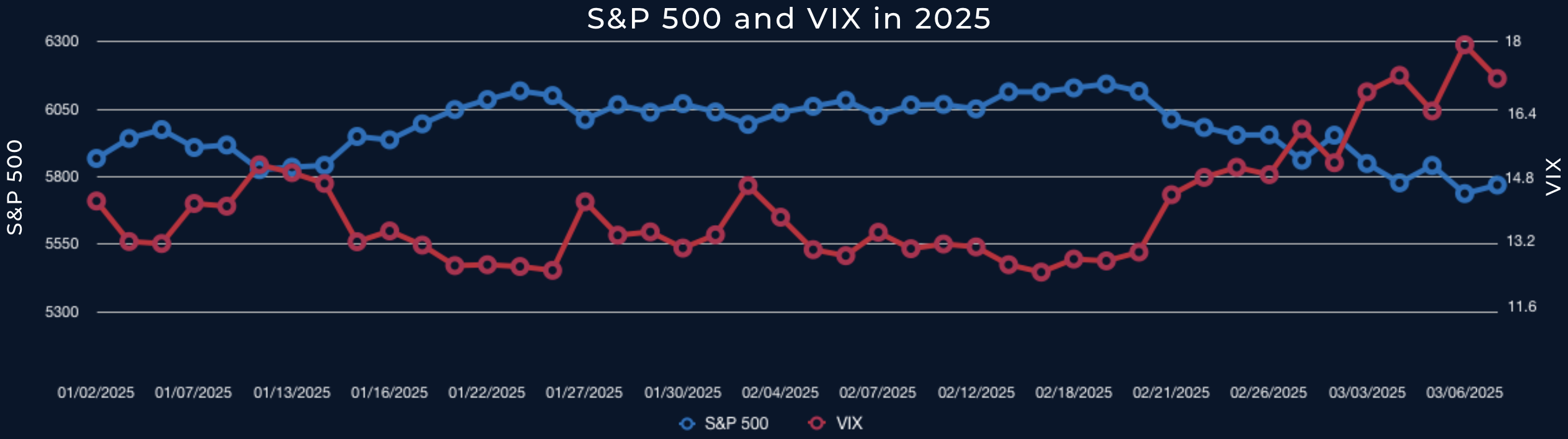
So far this year, the U.S. market has been shaken by a strong wave of volatility, marked by significant declines in key indices such as the S&P 500. Factors such as tariffs, recession fears, and uncertainty about inflation have created an unstable environment, prompting investors to question whether this correction is broad-based or merely a concentrated hit on specific sectors, such as technology.
Main Causes of Volatility
- Recession Fears: Uncertainty about economic growth and potential signs of a slowdown. As a result, Goldman Sachs has lowered its U.S. GDP growth forecast for 2025 from 2.4% to 1.7%.
- Trade Policies: Impact of tariffs imposed on Canada, Mexico, and China. Tariffs increase production costs, which can either reduce profit margins or be passed on to consumers in the form of higher prices.
- Trade Tensions: Retaliatory measures from these countries against the U.S., increasing the risk of a trade war.
All these factors have heightened uncertainty about the future of the market, as reflected in the rise of the VIX index, commonly known as the "fear index." Since the VIX has an inverse relationship with the S&P 500, its recent increase has coincided with market declines.
Overall Market Decline or Sector-Specific Correction?
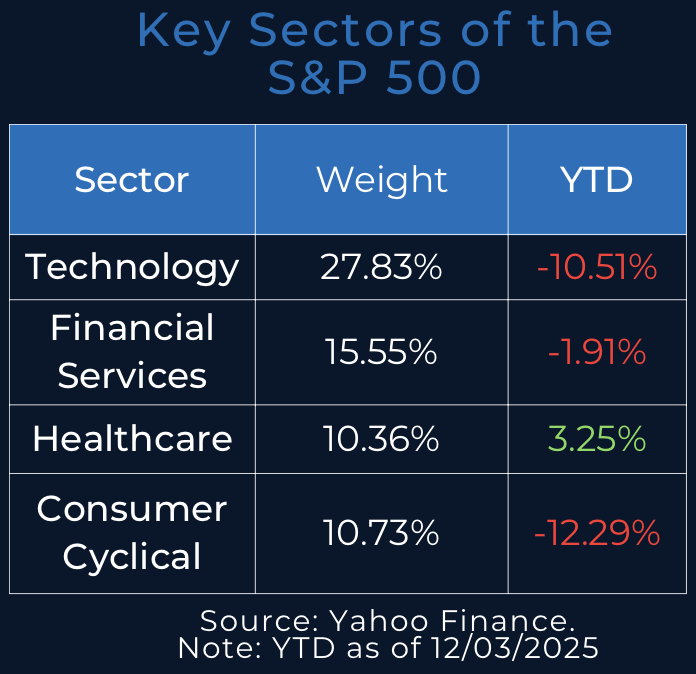
The S&P 500, an index comprising the 500 largest companies in the United States, has been one of the hardest hit this year. The most affected sector is technology, which accounts for approximately 27.83% of the index. Given its significant weight, the decline of major tech companies has been a key factor in the S&P 500’s drop. However, it has not been the only sector impacted—consumer discretionary has also recorded substantial losses. In contrast, the healthcare sector has shown resilience, with some companies standing out in performance.
At Numa Americas Corp, we continuously monitor market volatility, strategically adapting our approach to align with its dynamics and seize opportunities in the current landscape.


-
 Miami: 1200 Brickell Ave . No. 1950 Miami,
FL 33130.
Miami: 1200 Brickell Ave . No. 1950 Miami,
FL 33130.
-
New York: 14 Wall St. 20th Floor, New York City, NY, 10005